

A creative brief template is a one-page form you fill in before anyone makes an ad. For Meta ads it covers 12 fields: objective, product and offer, audience, problem, angle, hooks, proof, format and specs, outline, call to action and landing page, reference ads, and the test plan. A good brief turns one idea into an ad a designer can make without a meeting.
Most creative brief templates online are built for brand campaigns or agency projects. This one is built for paid social: it asks for hooks, proof and reference ads with real data behind them. You get the template to copy, how to fill in each field, and two filled-in examples built from AG1 and Jolie ads that are running today. It's part of our guide to what creative strategy is.
What is a creative brief?
A creative brief is the work order between the person who decides what to test and the person who makes the ad. On a small team that might be the same person on two different days. Either way, it forces you to write down the idea before you spend time and money producing it.
For ads, the brief has a second job: it's the record of what you tested. When an ad wins or loses, the brief tells you why it was made, which makes the next brief better. That's why the template below ends with a test plan.
What a good ad creative brief includes
These are the 12 fields that matter for Meta ads. Each one answers a question the person making the ad would otherwise have to ask.
- Objective. What this ad must do, in one sentence. "Test a new angle for cold audiences," not "drive awareness".
- Product and offer. The exact product, price and any offer, and the landing page it sends to.
- Audience. Who it's for and how much they already know: never heard of you, know the problem, or already compared options.
- Problem or desire. The one thing the buyer wants or wants to stop. Use their words, from reviews or comments.
- Angle. The single idea of the ad. One angle per brief.
- Hooks. 3 options for the first line or first frame, written out word for word.
- Proof. What makes the promise believable: a review, a number, an expert, a demo, a comparison.
- Format and specs. Static or video, length, and sizes. Meta's ad specs recommend 4:5 for Facebook Feed images and 9:16 for Instagram Stories.
- Outline. The layout of a static (headline, image, callouts) or the beats of a video with rough timings.
- Call to action and landing page. The button and the page. The page should match the angle.
- Reference ads. 2 to 3 live ads that already work, with links, how long each has run and why you picked it.
- Test plan. The one variable this ad tests, what it runs against and the metric that decides.
Add two short lines at the end: mandatories and don'ts (claims you can't make, legal lines, brand rules) and deliverables and deadline.
The ad creative brief template
Copy this into a doc, a Notion page or your project tool. Fill in every line; delete nothing.
AD CREATIVE BRIEF
Brief name:            [Brand] / [Angle] / [Format] / [Date]
Owner:                 [Who wrote it]       Maker: [Designer, editor or creator]

1. Objective:          [What this ad must do, one sentence]
2. Product and offer:  [Product, price, offer]
3. Audience:           [Who + awareness level: unaware / problem-aware / solution-aware / comparing]
4. Problem or desire:  [In the buyer's words, from reviews or comments]
5. Angle:              [The one idea]
6. Hooks (pick 3):
   a. [First line or first frame, word for word]
   b. [...]
   c. [...]
7. Proof:              [Review / number / expert / demo / comparison to show]
8. Format and specs:   [Static or video, length, 4:5 and 9:16 sizes]
9. Outline:            [Static: headline, image, callouts, button text]
                       [Video: 0-3s hook, problem, product working, proof, CTA]
10. CTA and landing:   [Button] -> [URL that matches the angle]
11. Reference ads:
   - [Link] [Brand] [runtime] [rank in brand's account] [what to take from it]
   - [...]
   - [...]
12. Test plan:         [The one variable] vs [current winner or control], judged on [metric]

Mandatories and don'ts: [Claims, disclaimers, brand rules]
Deliverables:           [Number of variations, sizes]   Due: [Date]
How to fill in a creative brief: step by step
Step 1: Start from the objective and the test
Write the objective and the test plan first, even though they sit at the top and bottom of the template. If you can't say what the ad is testing, you're not ready to brief it. "New angle for cold audiences, judged on cost per purchase against our current best static" is a brief. "A fresh ad for Q4" isn't.
Step 2: Pull the problem from real buyer words
Read your reviews, comments and support emails, and copy the phrases people use. "I'm doing everything right, why do I still feel like something's missing?" is a better problem line than "lack of energy", and AG1 uses that exact question in the copy of one of its most-served ads today. Put 2 to 3 of these phrases in field 4.
Step 3: Pick one angle and write 3 hooks
Choose one angle (a benefit, a fear, a comparison, a moment in the day) and write 3 hooks that open it in different ways: a question, a bold claim, a scene. Write them word for word. "Something about mornings" isn't a hook; "Stronger mornings start here." is.
Step 4: Choose the proof
Decide what will make the promise believable and say exactly where it comes from: the review and its star rating, the stat and its source, the expert and their credentials, or the demo shot. If you can't prove the claim, cut it from the brief. This is also where your mandatories go, so the maker knows which claims need a disclaimer.
Step 5: Find 2 to 3 reference ads that already work
Don't reference ads you like. Reference ads brands keep paying for. Look for ads in your category (or close to it) that have run for months and rank near the top of their brand's account, and write one line on what to take from each: the layout, the hook style, the proof.
Runtime is the clearest public signal: brands switch off ads that don't earn their spend. Our static ad examples and 50 best Facebook ad examples are full of them.
Step 6: Set the format, specs and deliverables
Say static or video, the length, and the sizes. For a static, ask for a 4:5 feed version and a 9:16 Stories and Reels version. Say how many variations you want (for example, one per hook) and the due date. Variations that change only the hook make the test easy to read.
Step 7: Review it against the test, then send
Read the brief once more and check that every field serves the one variable you're testing. If you're testing the hook, the proof, layout and landing page stay the same across variations. Then send it with the reference links, not screenshots, so the maker can watch the ads.
Example: a filled-in creative brief for AG1
To show the template working, here's a brief a strategist could write for a new AG1 Pro static after studying AG1's live ads in Adspo on November 1, 2026. It's our example, not AG1's internal brief. Every reference and number comes from AG1's ads as they ran that day.
AG1 had 501 creatives across 704 ads in Adspo that day. Its #1 and #3 most-served active creatives both promote AG1 Pro, the version with creatine, Ca-HMB and zinc carnosine, which tells you where the brand is pushing right now.
| Field | AG1 Pro example |
|---|---|
| Objective | Test a new static for AG1 Pro aimed at people who train, against the current "Stronger mornings" static. |
| Product and offer | AG1 Pro, no discount on the image. |
| Audience | People who already work out and know they "should" take creatine (solution-aware). |
| Problem or desire | Wanting more from training without adding another tub and another habit. |
| Angle | One scoop covers daily nutrition and creatine. |
| Hooks | a. "Your pre-gym scoop just got stronger." b. "Creatine and greens. One scoop." c. "The hardest part of training isn't always the workout." (from AG1's own creator video) |
| Proof | Ingredient callouts on the image: 5g creatine monohydrate, Ca-HMB. Use only the claims and asterisks already on AG1's approved ads. |
| Format and specs | Static, 4:5 for feed and 9:16 for Stories and Reels. |
| Outline | Headline at the top, a person mixing AG1 Pro at a kitchen counter after a workout, 2 ingredient callouts, the AG1 Pro box in the corner. |
| CTA and landing | Learn More, to the AG1 Pro gut and muscle page used by the current static. |
| Reference ads | The 3 ads below. |
| Test plan | Same image, 3 hook variations, against the current "Stronger mornings" static, judged on cost per purchase. |
| Mandatories | Keep the supplement disclaimer asterisks AG1 already uses. No body-transformation claims. |
Reference 1: AG1's "Stronger mornings" static
This is the control the new ad has to beat. A man mixes AG1 Pro into a glass at a kitchen counter, with two ingredient callouts and the headline in AG1's green highlight.
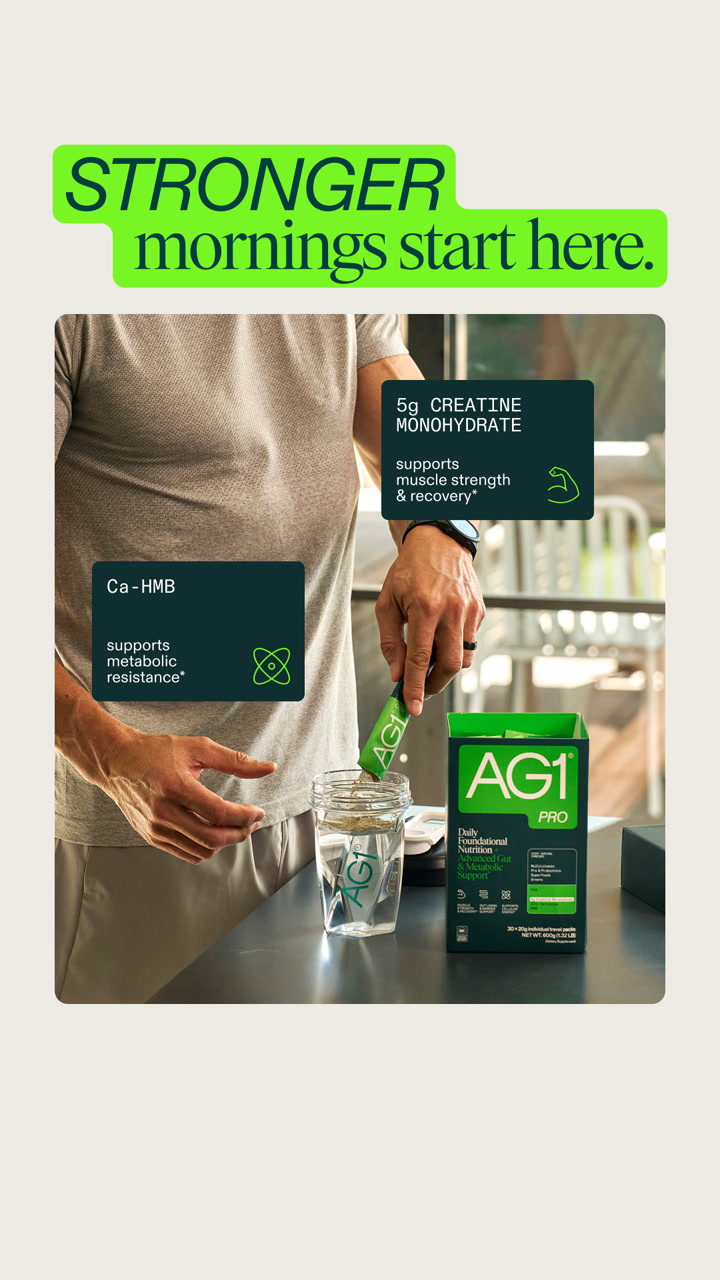

- Running for: 137 days (since June 2026), still active
- Impression rank: #3 of AG1's creatives
- What to take: the layout. Headline, a real moment of use, and two callouts that each name one ingredient and one benefit.
Reference 2: AG1's most-served creative right now
A demo video for the same product, with the headline "Make a Pro Move" and copy that lists the three added ingredients.
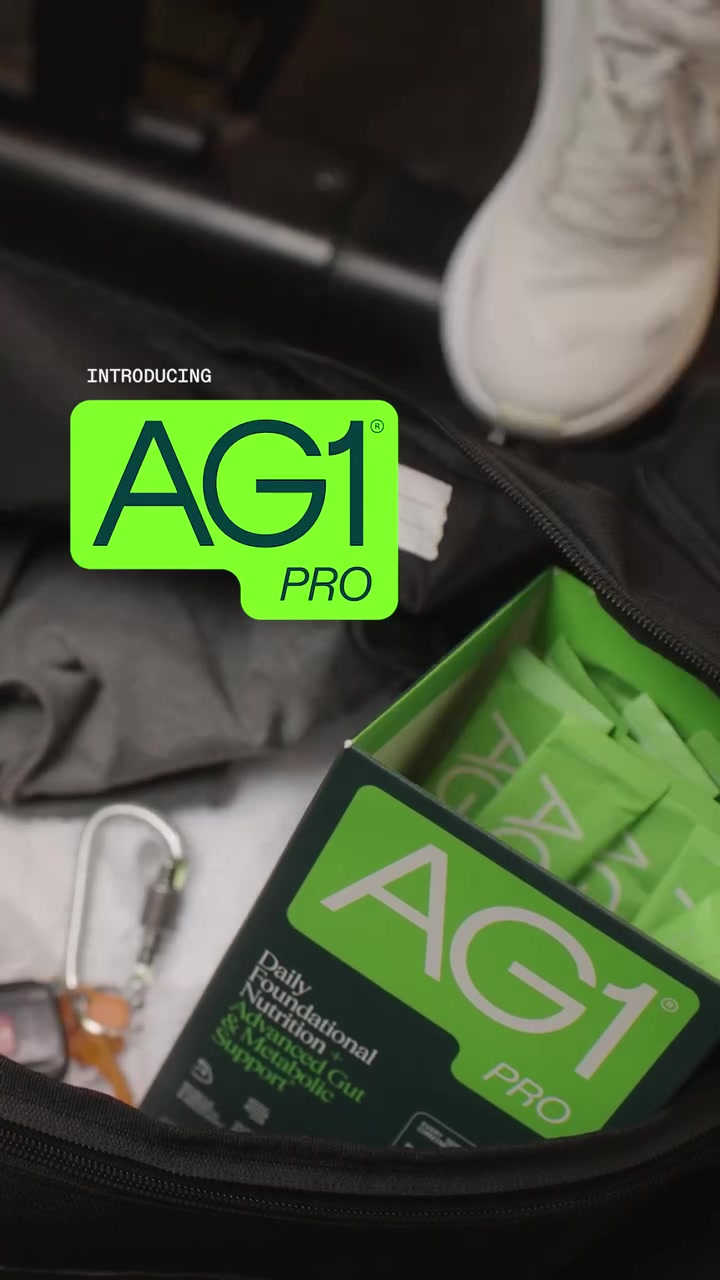
- Running for: 137 days (since June 2026), still active
- Impression rank: #1 of AG1's creatives
- What to take: the "pro" language. It's the message AG1 is serving most, so the new static should speak to the same buyer.
Reference 3: the expert quote static
A static with a doctor on a sofa, an AG1 bottle in hand and a short quote over the photo.
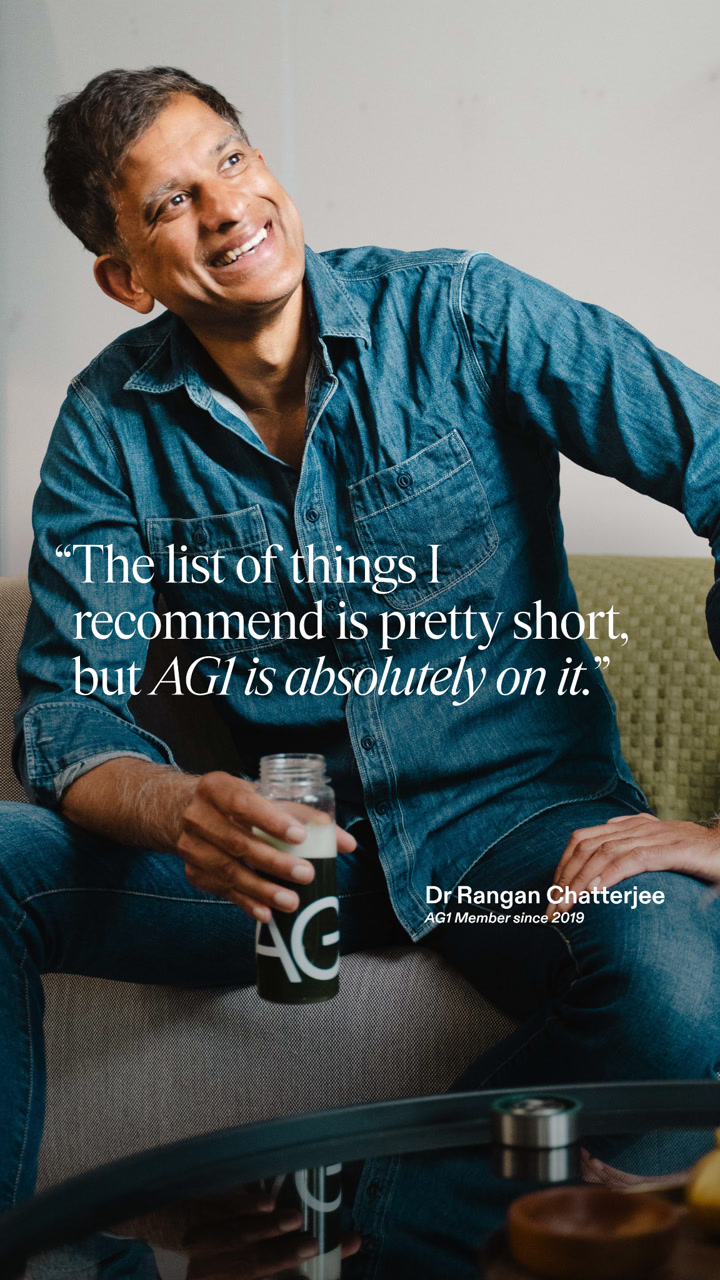
- Running for: 141 days (since June 2026), still active
- Impression rank: #6 of AG1's creatives
- What to take: a proof option for a later round. If the hook test finds a winner, test an expert quote as the next variable.
Example: a short static brief for Jolie
Not every brief needs to be long. Jolie's most-served creative is a static that has run for 600 days (since March 2025) and is used in 33 ads: a brass filtered shower head with eucalyptus and an "As seen in Vogue" badge.
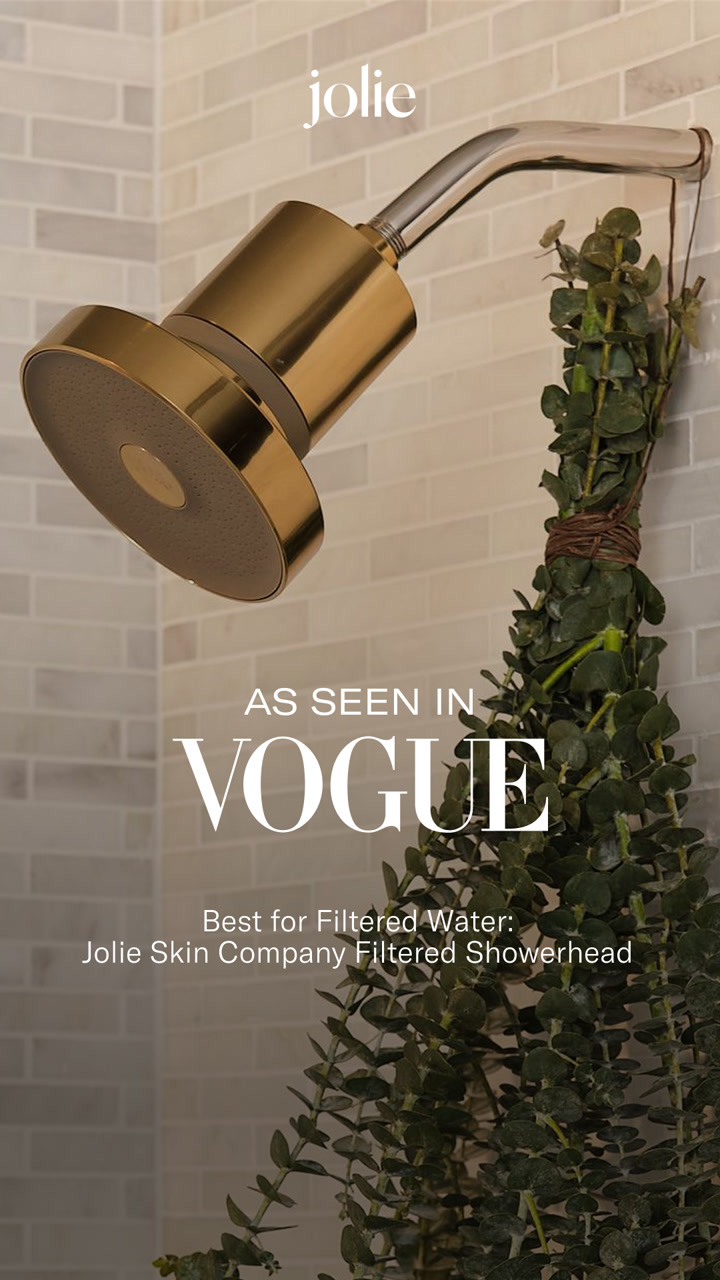

A brief to iterate on it might read:
| Field | Jolie example |
|---|---|
| Objective | Find a second press-led static to run next to the Vogue static. |
| Angle | Press proof on a beautiful product photo. |
| Hooks | Swap the badge: a different outlet, a "Best for" award, or the "Trusted by over 800,000 customers" line from the current copy. |
| Proof | The press mention or award, used exactly as published. |
| Format | Static, 4:5 and 9:16. Same photo style. |
| CTA and landing | Learn More, to the filtered showerhead product page. |
| Reference ads | The Vogue static above (600 days, #1 of Jolie's creatives). |
| Test plan | Badge variations only, judged against the Vogue static on cost per purchase. |
That's the whole brief. The reference ad does most of the explaining.
Mistakes to avoid
- Several angles in one brief. You get an ad that says three things and a test you can't read. Split it into three briefs.
- Vague hooks. "Something punchy about sleep" leaves the hard part to the maker. Write the words.
- References with no evidence. An ad you saw once might have been switched off a day later. Use ads with months of runtime.
- No landing page. An ad about a specific problem that sends people to the homepage wastes the angle.
- Claims nobody checked. Put every number and quote's source in the proof field, or leave it out.
- No test plan. Without one, you'll judge the ad on taste. Decide the variable and the metric before it's made.
For how to run the test once the ads are made, see our creative testing framework and how many ads to test per week.
Use Adspo to fill in your references and proof faster
The slow part of any brief is the research: finding ads that already work, seeing what a competitor pushes right now, and pulling the hooks and copy behind them. The free Meta Ad Library shows live ads and start dates, but it can't tell you which ones a brand serves most or sort them by how long they've run.
Adspo does that for 10,000+ verified brands:
- Sort any brand's ads by longest running or most impressions, to find the references worth putting in a brief.
- Impression rank within the brand's account, so you know a reference is a scaled winner, not a test.
- Hooks, transcripts, copy and landing pages for every creative, ready to quote in the angle and proof fields.
- Boards, to save references per brief and share them with the maker.
Here's AG1's brand page in Adspo, with its creatives, ads, media mix and creative velocity (screenshot from October 9, 2026):
 AG1's brand page in the Adspo app showing its creatives, ads, creative velocity, media mix, target countries, landing pages and visual formats
And its active creatives sorted by longest running, the quickest way to find reference ads for a brief:
 AG1's active creatives in the Adspo app sorted by longest running, each card showing its runtime badge
Adspo costs $29/month, or $19/month billed yearly, with a 7-day free trial.
Frequently asked questions
What is a creative brief in advertising?
A creative brief is a one-page document that tells a designer, editor or creator what an ad must do before they make it: the objective, the audience, the angle, the hooks to try, the proof to show, the format and specs, the call to action and landing page, and 2 to 3 reference ads. It keeps everyone working toward the same idea and makes the result easy to judge.
What should a creative brief template include?
For paid social ads, include: objective, product and offer, audience and awareness level, the problem or desire, one angle, 3 hook options, proof, format and specs, a script or layout outline, call to action and landing page, reference ads, mandatories and don'ts, and how the ad will be tested. Leave out brand history and long mission statements: the person making the ad doesn't need them.
How long should a creative brief be?
One page. If it doesn't fit on one screen, the angle probably isn't clear yet. Write one brief per concept, not one per campaign, so each brief has one idea and one set of hooks.
What is the difference between a creative brief and a creative strategy?
Creative strategy decides which angles, audiences and formats are worth testing across your whole account. A creative brief turns one of those decisions into instructions for one ad or one set of variations. Strategy is the plan; the brief is the work order.
What is a good creative brief example?
A good brief is specific enough that two different designers would make similar ads. The AG1 example in this post names one angle (a stronger morning for people who train), three exact hooks, the ingredients to show as proof, the sizes, the landing page and three live AG1 ads as references, each with how long it has run and where it ranks in AG1's account.
How do you write a creative brief for a video ad?
Use the same template, and write the outline as beats with rough timings: the hook in the first seconds, the problem, the product shown working, the proof, then the call to action. Say whether it should be a creator talking to camera, a demo or a polished edit, and add a reference video that already runs for a long time.
Wrapping it up
A good ad creative brief is one page with one idea: the objective, the audience, one angle, 3 hooks written out, the proof, the specs, the landing page, 2 to 3 reference ads that already work, and the test that will judge the result.
Copy the template, fill in the references from ads brands keep paying for, and log what each brief taught you. Try Adspo free for 7 days to find those references in minutes.